How does resource collection work in The Maker Way?
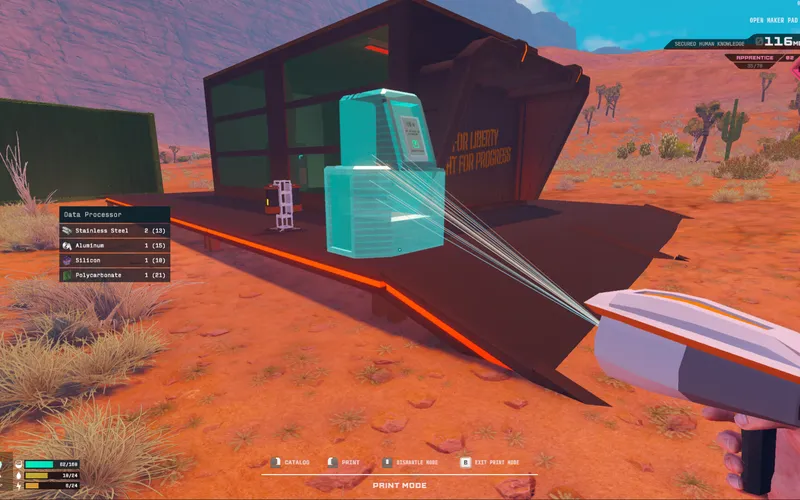
Resource gathering in The Maker Way avoids repetitive pickaxe swinging by employing handheld and machine-mounted disintegration tools. Players explore industrial ruins, abandoned mining sites, and battlefield wreckage across Arizona, targeting resource nodes with molecular deconstructors. Harvested raw materials flow directly into storage bins to feed base 3D-printing fabricators and fuel refineries.
The Demo 2.0 Disintegration Overhaul
Official patch notes for Demo version 0.0.25 introduced a fundamental shift in how players gather materials:
- Legacy System: Disintegrating a scrap heap previously yielded an indiscriminate mixture of all contained materials, cluttering inventory slots with unneeded elements.
- Selective Breakdown System: Modern disintegration breaks composite piles down into distinct, single-resource fragments. Players can pick and choose precisely which elements to gather based on active print schematics.
- Targeted Harvesting: Focus on rare conductive metals for hacking electronics while leaving bulky low-grade gravel in the field to preserve vehicle cargo limits.
(Exact breakdown conversion tables and yield percentages per cubic meter: 官方尚未公布 / Not yet announced)
Confirmed Resource Tiers & Usage
| Material Family | Primary Source | Extraction Method | Major Manufacturing Use |
|---|---|---|---|
| Structural Minerals | Surface desert boulders & quarry cuts | Heavy Mining Heads | Basic chassis blocks & outpost walls |
| Refined Conductive Metals | Government bunker electronics & relay wreckage | Precision Disintegration | Circuit boards, antennas, & radar scanners |
| Hydrocarbon Deposits | Oil seep basins & refinery fuel tanks | Fluid Extractors | Combustion engine fuel & plastic composites |
| High-Density Ballistic Alloys | Downed military robot wrecks & turret scrap | High-Energy Disintegration | Heavy vehicle armor plates & armor-piercing shells |
(Precise alloy ratios and chemical refining formulas: 官方尚未公布 / Not yet announced)
Resource Logistics & Storage Flow
[ Field Scrap / Node ] ---> [ Disintegration Tool ] ---> [ Rover Cargo Bin ]
                                                                 |
[ 3D Print Fabricator ] <--- [ Outpost Storage Silo ] <---+ [ Unloading Pad ]- Equip Dedicated Mining Heads: While handheld tools work for small caches, mounting a high-output disintegration beam on a rover significantly speeds up bulk collection.
- Sort by Density: Heavy raw ores rapidly consume suspension weight allowances; prioritize transporting refined ingots and rare electronics over unrefined stone.
- Automate Silo Ingestion: Connect cargo drop pads to automated sorting hoppers at your outpost to keep printers supplied without manual inventory transfers.
Frequently Asked Questions
Do resource nodes respawn in the desert?
Surface nodes and abandoned scrap piles are distributed across the open world. Long-term node replenishment rates across desert sectors have not been officially confirmed by developer Brave Games Inc.
Can you disintegrate defeated enemy robots?
Yes. Downed government patrol robots and drones remain in the field as salvagable wrecks that can be broken down for high-tier technological components.
Is there an encumbrance penalty for carrying too many materials?
Vehicle cargo capacity is governed by physical suspension loads and engine thrust limits. Exceeding recommended payloads causes rovers to bottom out and slows acceleration.